• Jobs of the World
  • Mentoring Programme
  • Login for Grantees
  • Code of Conduct
  • About
    • History
    • Investigators
    • Team
  • Projects
    • GLM|LIC
      • Agricultural Labour Markets
      • Gender and Employment
      • Labour Markets in Low-Income Countries
      • Migration
      • Skill Training
    • G²LM|LIC
      • Fact & Policy
      • Fertility & Labour markets
      • Barriers to gender parity
      • The Future of Work
      • Policies & Welfare
    • COVID-19
  • Publications
    • Policy Briefs
    • Synthesis Papers
    • Working Papers
    • Published Articles
    • Book
    • Datasets
  • Events
  • For Policy Makers
Search
  • Skip to main content
  • Skip to primary sidebar
G²LM|LIC Policy Brief No. 92

Does the Firm Matter More than the Job? Unpacking the Gender Wage Gap in Nairobi, Kenya

Fertility & Labour markets
Occupational Segregation and Gender Gaps in Nairobi

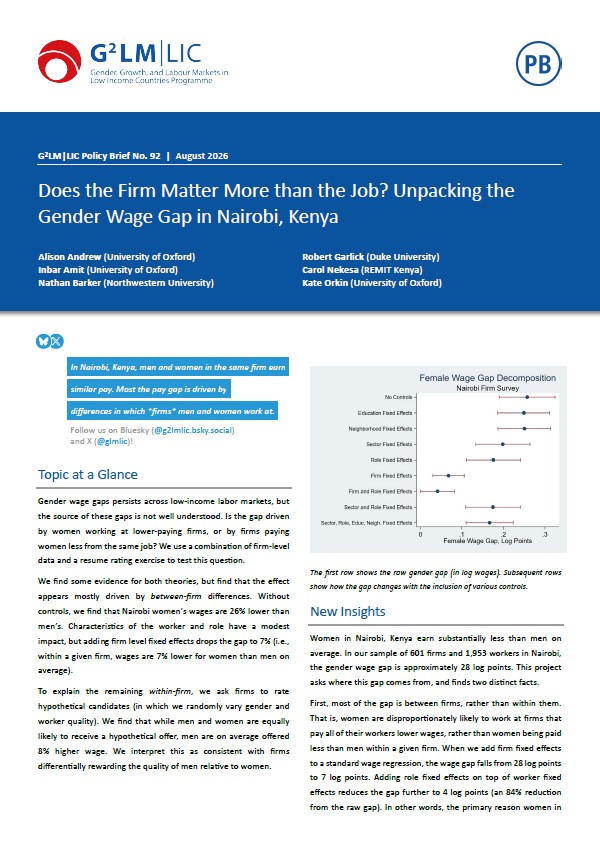
Gender wage gaps persists across low-income labor markets, but the source of these gaps is not well understood. Is the gap driven by women working at lower-paying firms, or by firms paying women less from the same job? We use a combination of firm-level data and a resume rating exercise to test this question.

We find some evidence for both theories, but find that the effect appears mostly driven by between-firm differences. Without controls, we find that Nairobi women’s wages are 26% lower than men’s. Characteristics of the worker and role have a modest impact, but adding firm level fixed effects drops the gap to 7% (i.e., within a given firm, wages are 7% lower for women than men on average).

To explain the remaining within-firm, we ask firms to rate hypothetical candidates (in which we randomly vary gender and worker quality). We find that while men and women are equally likely to receive a hypothetical offer, men are on average offered 8% higher wage. We interpret this as consistent with firms differentially rewarding the quality of men relative to women.
G²LM|LIC Policy Brief No. 92

Does the Firm Matter More than the Job? Unpacking the Gender Wage Gap in Nairobi, Kenya

  • Alison Andrew
  • Inbar Amit
  • Nathan Barker
  • Robert Garlick
  • Carolyne Nekesa
  • Kate Orkin
Download the PDF

sidebar

Subscribe to our mailing list
Contact us
Follow us on Bluesky
Follow us on X

Established in 1998 in Bonn, Germany, IZA is an independent, non-profit research institution supported by the Deutsche Post Foundation with a focus on the analysis of global labour markets. It operates an international network of about 1,500 economists and researchers spanning across more than 50 countries.

Based on academic excellence and an ambitious publication strategy, IZA serves as a place of communication between academic science and political practice.

The Foreign, Commonwealth & Development Office (FCDO) leads the UK's work to end extreme poverty. We're ending the need for aid by creating jobs, unlocking the potential of girls and women, and helping to save lives when humanitarian emergencies hit.

FCDO is a ministerial department, supported by 12 agencies and public bodies.

© 2012–2026 | IZA – Institute of Labor Economics | Code of Conduct | Imprint