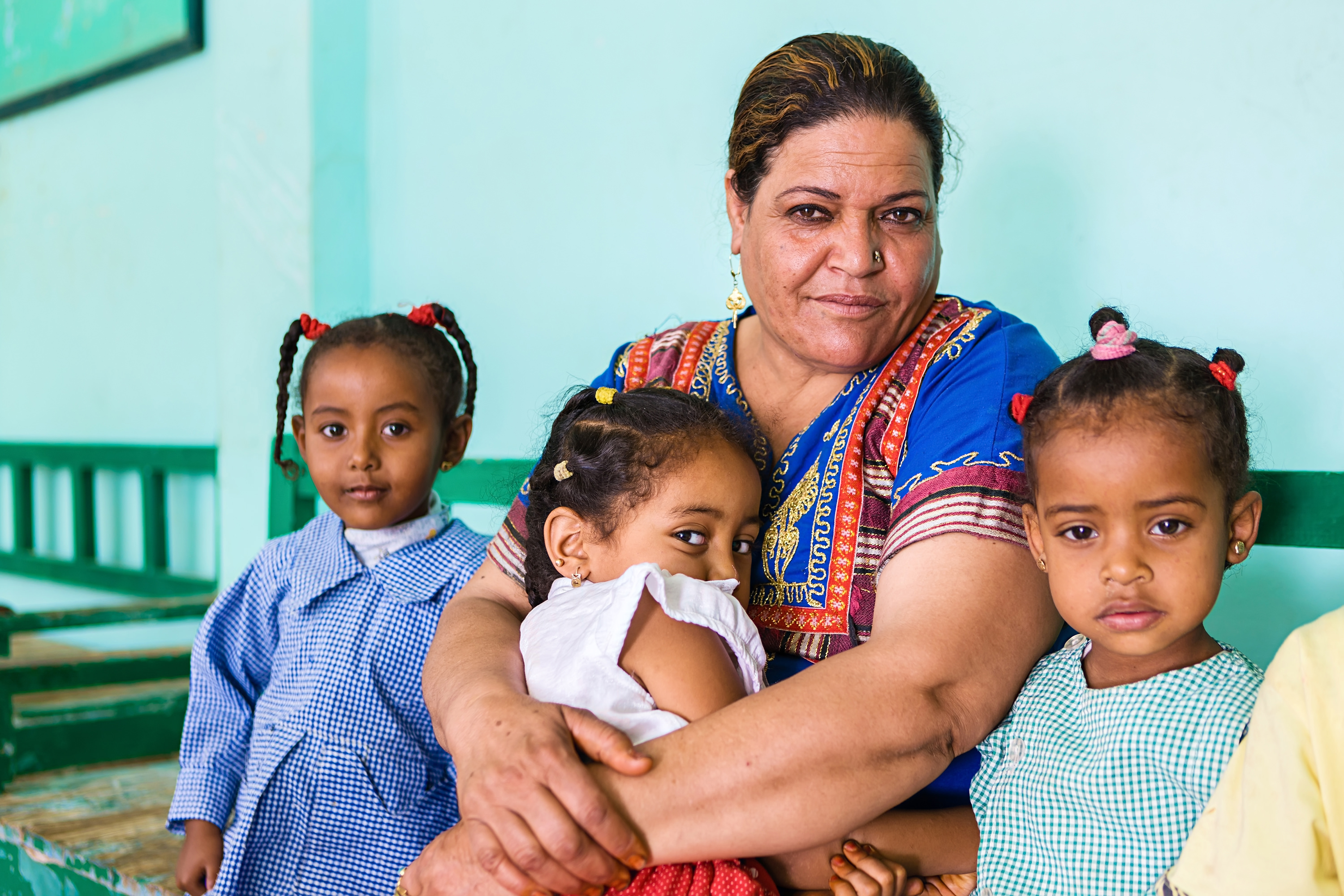
There are three main explanations for why female labor force participation (FLFP) remains low globally: (1) women’s high opportunity cost of time, (2) weak labor demand, and (3) restrictive gender norms. This project examined all three constraints on FLFP in a low-income context in Egypt. Specifically, the study addressed the following research questions: (i) whether lowering the cost of childcare increased the labor supply of economically vulnerable mothers; (ii) whether childcare subsidies were more effective when combined with employment services and when gender norms were more favorable to female employment; (iii) whether childcare subsidies generated dynamic effects on employers’ demand for female workers and on gender norms; and (iv) what impact expanded nursery usage had on children’s development.
The ability to afford childcare was identified as a major constraint on women’s labor market participation. In Egypt, only 8 percent of children aged 0 to 4 years were enrolled in registered nursery programs (UNICEF Egypt 2019). Private nursery fees often implied that women faced negative net earnings after childcare expenses. High female turnover, largely driven by domestic responsibilities, contributed to employer discrimination against women, while traditional breadwinner–homemaker norms further constrained female employment.
The project targeted women living in low-income informal settlements in Greater Cairo and implemented a randomized controlled trial to evaluate the effects of childcare subsidies and employment services on women’s employment outcomes. Childcare subsidies alleviated opportunity cost of time constraints, while employment services addressed labor demand. Evaluating these interventions jointly allowed the study to identify the interaction and relative importance of different barriers to women’s employment. Using baseline data on household gender norms, the analysis assessed whether intervention impacts varied by pre-existing gender role attitudes.
While a substantial literature has examined early childhood care and education (ECCE) access and women’s employment in developed countries (Connelly 1992; Meyers, Heintze, and Wolf 2002), rigorous evidence from developing countries remains limited (Angeles et al. 2012; Attanasio, Carneiro, and Olinto 2017; Berlinski, Galiani, and McEwan 2011). This project contributed new causal evidence from a setting where labor demand conditions and social norms significantly shape the ECCE–FLFP relationship.
The study was implemented in partnership with Kheir wa Baraka (KwB), a Cairo-based NGO located in the city’s largest informal settlement. KwB has over a decade of experience operating nursery programs and has been contracted by Egypt’s Ministry of Social Solidarity (MoSS) to support NGO-run nurseries serving children aged 0 to 6 in low-income areas of Greater Cairo. The research was conducted within defined nursery catchment areas. KwB also provided employment services linking women to job opportunities. MoSS expressed strong interest in understanding the labor market impacts of nursery access and in designing effective subsidy targeting, which this project directly addressed.
The research team conducted household surveys using random door-to-door sampling within each catchment area to identify eligible mothers with children aged 0 to 6. During baseline visits, mothers were informed of their randomized childcare subsidy level and whether they were assigned to receive employment services. Employers participating in the employment services were also surveyed at baseline, and the study randomized whether employers received information about applicants’ access to childcare subsidies.
Mothers were surveyed at four points in time: baseline (prior to intervention), four months after baseline (midline 1), one year after baseline (midline 2, shortly before the 12-month subsidy ended), and six months after subsidies ended (endline). The evaluation estimated the impacts of childcare subsidies at varying price points, employment services, and their interaction on women’s labor market outcomes. The study also examined dynamic responses on the employer side.
The analysis assessed both policy-relevant final outcomes and intermediate mechanisms. For mothers, outcomes included employment, reservation wages, individual and household earnings, job quality, well-being, time use, intra-household bargaining power, and gender role attitudes. The study paid particular attention to how impacts varied by baseline norms and whether employment and childcare access shifted these norms over time. For children, the evaluation measured a comprehensive set of cognitive and non-cognitive development outcomes.
Overall, the completed project generated evidence to inform the scale-up strategies of the Ministry of Social Solidarity, the ongoing work of Kheir wa Baraka and other nursery providers, and broader policy efforts aimed at increasing women’s labor force participation while supporting early childhood development in low-income contexts.