• Jobs of the World
  • Mentoring Programme
  • Login for Grantees
  • Code of Conduct
  • About
    • History
    • Investigators
    • Team
  • Projects
    • GLM|LIC
      • Agricultural Labour Markets
      • Gender and Employment
      • Labour Markets in Low-Income Countries
      • Migration
      • Skill Training
    • G²LM|LIC
      • Fact & Policy
      • Fertility & Labour markets
      • Barriers to gender parity
      • The Future of Work
      • Policies & Welfare
    • COVID-19
  • Publications
    • Policy Briefs
    • Synthesis Papers
    • Working Papers
    • Published Articles
    • Book
    • Datasets
  • Events
  • For Policy Makers
Search
  • Skip to main content
  • Skip to primary sidebar
G²LM|LIC Policy Brief No. 84

Work and Motherhood

Female Employment does not Reduce Fertility

Fertility & Labour markets
Long-Run Impacts of Factory Jobs: Labour Market Outcomes, Wellbeing, and Fertility in Ethiopia

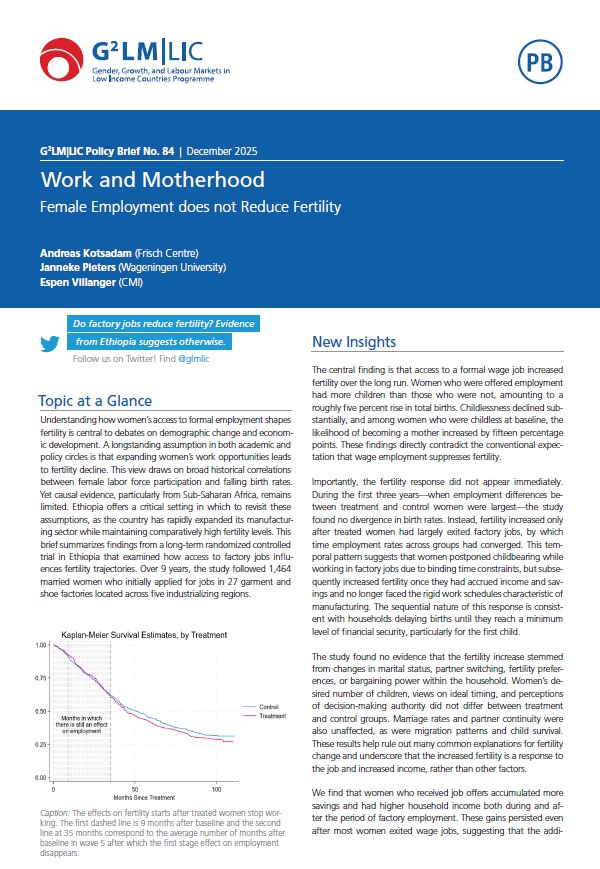
Understanding how women’s access to formal employment shapes fertility is central to debates on demographic change and economic development. A longstanding assumption in both academic and policy circles is that expanding women’s work opportunities leads to fertility decline. This view draws on broad historical correlations between female labor force participation and falling birth rates. Yet causal evidence, particularly from Sub-Saharan Africa, remains limited. Ethiopia offers a critical setting in which to revisit these assumptions, as the country has rapidly expanded its manufacturing sector while maintaining comparatively high fertility levels. This brief summarizes findings from a long-term randomized controlled trial in Ethiopia that examined how access to factory jobs influences fertility trajectories. Over 9 years, the study followed 1,464 married women who initially applied for jobs in 27 garment and shoe factories located across five industrializing regions.
G²LM|LIC Policy Brief No. 84

Work and Motherhood

Female Employment does not Reduce Fertility

  • Andreas Kotsadam
  • Janneke Pieters
  • Espen Villanger
Download the PDF

sidebar

Subscribe to our mailing list
Contact us
Follow us on Bluesky
Follow us on X

Established in 1998 in Bonn, Germany, IZA is an independent, non-profit research institution supported by the Deutsche Post Foundation with a focus on the analysis of global labour markets. It operates an international network of about 1,500 economists and researchers spanning across more than 50 countries.

Based on academic excellence and an ambitious publication strategy, IZA serves as a place of communication between academic science and political practice.

The Foreign, Commonwealth & Development Office (FCDO) leads the UK's work to end extreme poverty. We're ending the need for aid by creating jobs, unlocking the potential of girls and women, and helping to save lives when humanitarian emergencies hit.

FCDO is a ministerial department, supported by 12 agencies and public bodies.

© 2012–2026 | IZA – Institute of Labor Economics | Code of Conduct | Imprint