• Jobs of the World
  • Mentoring Programme
  • Login for Grantees
  • Code of Conduct
  • About
    • History
    • Investigators
    • Team
  • Projects
    • GLM|LIC
      • Agricultural Labour Markets
      • Gender and Employment
      • Labour Markets in Low-Income Countries
      • Migration
      • Skill Training
    • G²LM|LIC
      • Fact & Policy
      • Fertility & Labour markets
      • Barriers to gender parity
      • The Future of Work
      • Policies & Welfare
    • COVID-19
  • Publications
    • Policy Briefs
    • Synthesis Papers
    • Working Papers
    • Published Articles
    • Book
    • Datasets
  • Events
  • For Policy Makers
Search
  • Skip to main content
  • Skip to primary sidebar
G²LM|LIC Policy Brief No. 93

The Price of Flexibility: Revealing Salaries in Job Postings

How Pay Transparency Reshapes Women’s Job Search: Evidence from a Field Experiment

Policies & Welfare
Market-Based Solutions to Gender Inequality in Job Search in Pakistan

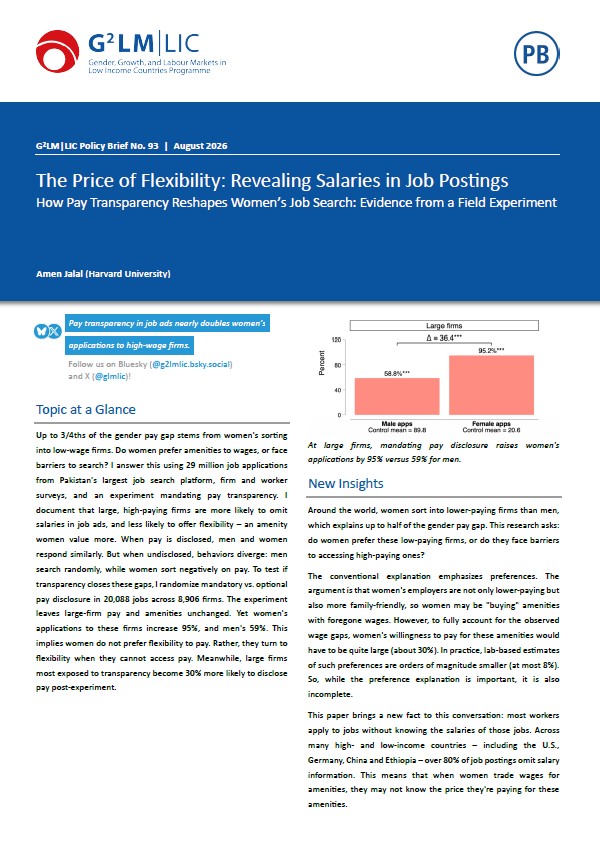
Up to 3/4ths of the gender pay gap stems from women’s sorting into low-wage firms. Do women prefer amenities to wages, or face barriers to search? I answer this using 29 million job applications from Pakistan’s largest job search platform, firm and worker surveys, and an experiment mandating pay transparency. I document that large, high-paying firms are more likely to omit salaries in job ads, and less likely to offer flexibility – an amenity women value more. When pay is disclosed, men and women respond similarly. But when undisclosed, behaviors diverge: men search randomly, while women sort negatively on pay. To test if transparency closes these gaps, I randomize mandatory vs. optional pay disclosure in 20,088 jobs across 8,906 firms. The experiment leaves large-firm pay and amenities unchanged. Yet women’s applications to these firms increase 95%, and men’s 59%. This implies women do not prefer flexibility to pay. Rather, they turn to flexibility when they cannot access pay. Meanwhile, large firms most exposed to transparency become 30% more likely to disclose pay post-experiment.
G²LM|LIC Policy Brief No. 93

The Price of Flexibility: Revealing Salaries in Job Postings

How Pay Transparency Reshapes Women’s Job Search: Evidence from a Field Experiment

  • Amen Jalal
Download the PDF

sidebar

Subscribe to our mailing list
Contact us
Follow us on Bluesky
Follow us on X

Established in 1998 in Bonn, Germany, IZA is an independent, non-profit research institution supported by the Deutsche Post Foundation with a focus on the analysis of global labour markets. It operates an international network of about 1,500 economists and researchers spanning across more than 50 countries.

Based on academic excellence and an ambitious publication strategy, IZA serves as a place of communication between academic science and political practice.

The Foreign, Commonwealth & Development Office (FCDO) leads the UK's work to end extreme poverty. We're ending the need for aid by creating jobs, unlocking the potential of girls and women, and helping to save lives when humanitarian emergencies hit.

FCDO is a ministerial department, supported by 12 agencies and public bodies.

© 2012–2026 | IZA – Institute of Labor Economics | Code of Conduct | Imprint