Over the past two decades, South Asia has experienced rapid economic growth and urbanisation, expanding the range of economic opportunities in the region. How strongly is access to new opportunities shaped by family background? And does growing up in a city rather than a village change a child’s prospects?
Our paper studies these questions through the lens of intergenerational mobility. Economic growth has substantially raised average living standards in South Asia, but evidence from India suggests that intergenerational mobility remains low. That is to say: a child born in 1990 at the bottom of the socioeconomic distribution was no more likely to rise to a higher relative status level than a child born in 1950 (Asher, Novosad, Rafkin 2024).
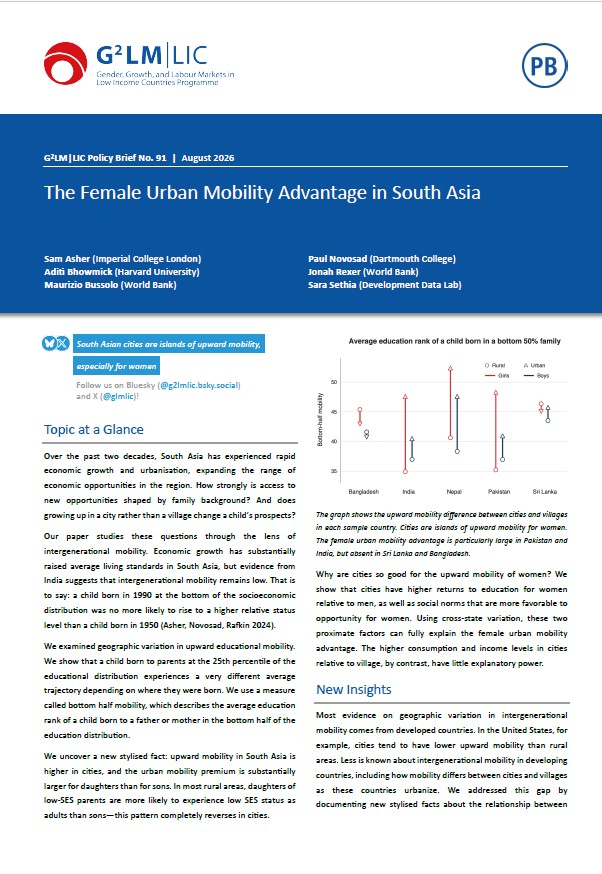
We examined geographic variation in upward educational mobility. We show that a child born to parents at the 25th percentile of the educational distribution experiences a very different average trajectory depending on where they were born. We use a measure called bottom half mobility, which describes the average education rank of a child born to a father or mother in the bottom half of the education distribution.
We uncover a new stylised fact: upward mobility in South Asia is higher in cities, and the urban mobility premium is substantially larger for daughters than for sons. In most rural areas, daughters of low-SES parents are more likely to experience low SES status as adults than sons—this pattern completely reverses in cities.
Why are cities so good for the upward mobility of women? We show that cities have higher returns to education for women relative to men, as well as social norms that are more favorable to opportunity for women. Using cross-state variation, these two proximate factors can fully explain the female urban mobility advantage. The higher consumption and income levels in cities relative to village, by contrast, have little explanatory power.
The Female Urban Mobility Advantage in South Asia
- Sam Asher
- Aditi Bhowmick
- Paul Novosad
- Maurizio Bussolo
- Jonah Rexer
- Sara Sethia