We tend to think of transit as moving people to jobs. But what if it also moved jobs to people?
India has among the lowest female labour force participation rates in the world, around 10% in Delhi in the early 2000s and 20% nationally. This research asks whether the Delhi Metro raised female employment mainly by reducing commute costs, or also through the types of firms drawn to locate near stations.
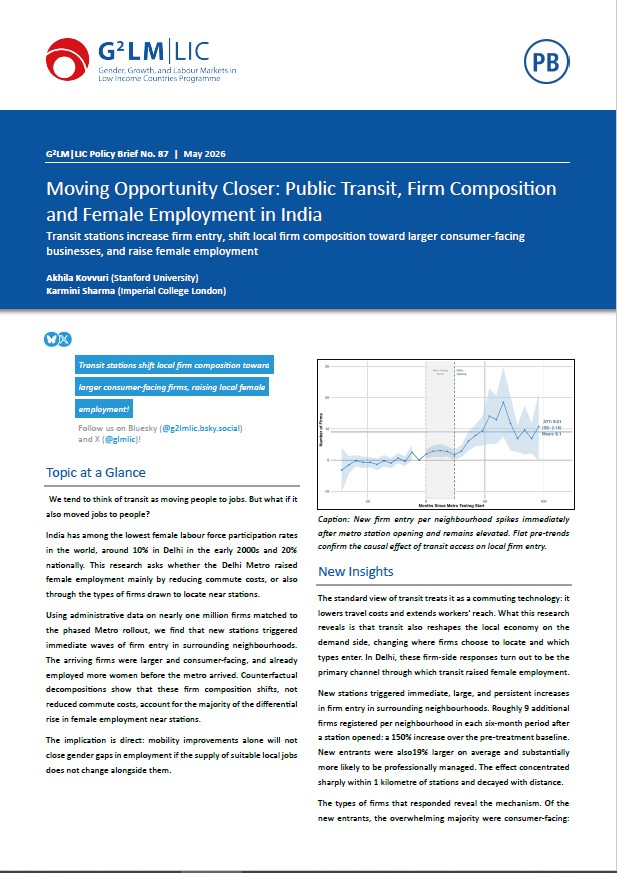
Using administrative data on nearly one million firms matched to the phased Metro rollout, we find that new stations triggered immediate waves of firm entry in surrounding neighbourhoods. The arriving firms were larger and consumer-facing, and already employed more women before the metro arrived. Counterfactual decompositions show that these firm composition shifts, not reduced commute costs, account for the majority of the differential rise in female employment near stations.
The implication is direct: mobility improvements alone will not close gender gaps in employment if the supply of suitable local jobs does not change alongside them.