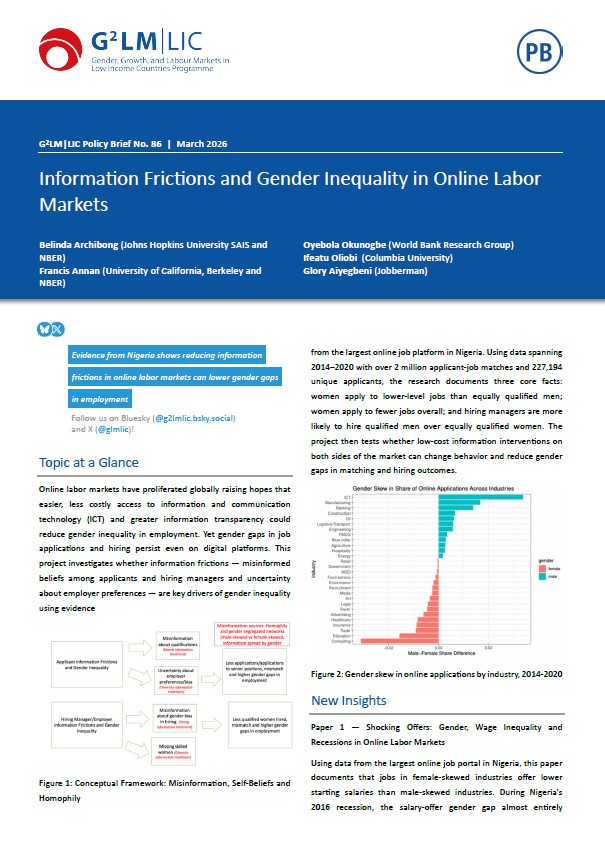
Online labor markets have proliferated globally raising hopes that easier, less costly access to information and communication technology (ICT) and greater information transparency could reduce gender inequality in employment. Yet gender gaps in job applications and hiring persist even on digital platforms. This project investigates whether information frictions — misinformed beliefs among applicants and hiring managers and uncertainty about employer preferences — are key drivers of gender inequality using evidence from the largest online job platform in Nigeria. Using data spanning 2014–2020 with over 2 million applicant-job matches and 227,194 unique applicants, the research documents three core facts: women apply to lower-level jobs than equally qualified men; women apply to fewer jobs overall; and hiring managers are more likely to hire qualified men over equally qualified women. The project then tests whether low-cost information interventions on both sides of the market can change behavior and reduce gender gaps in matching and hiring outcomes.
Information Frictions and Gender Inequality in Online Labor Markets
- Belinda Archibong
- Francis Annan
- Oyebola Okunogbe
- Ifeatu Oliobi
- Glory Aiyegbeni