Structural transformation is often characterised as a reallocation of labour from agriculture to manufacturing and services. An equally important dimension, however, is the reorganisation of work from small-scale self-employment and family production to wage employment in larger firms. This transformation has proceeded slowly in sub-Saharan Africa, where self-employment dominates and large firms capable of generating stable wage jobs at scale remain rare. At the same time, attention has focused primarily on urban and manufacturing job creation, even though rural areas still house most of the population and will absorb a large share of new labour market entrants for decades to come. Whether stable wage jobs can emerge in rural areas and seed the growth of new towns and cities is therefore central to the region’s development trajectory.
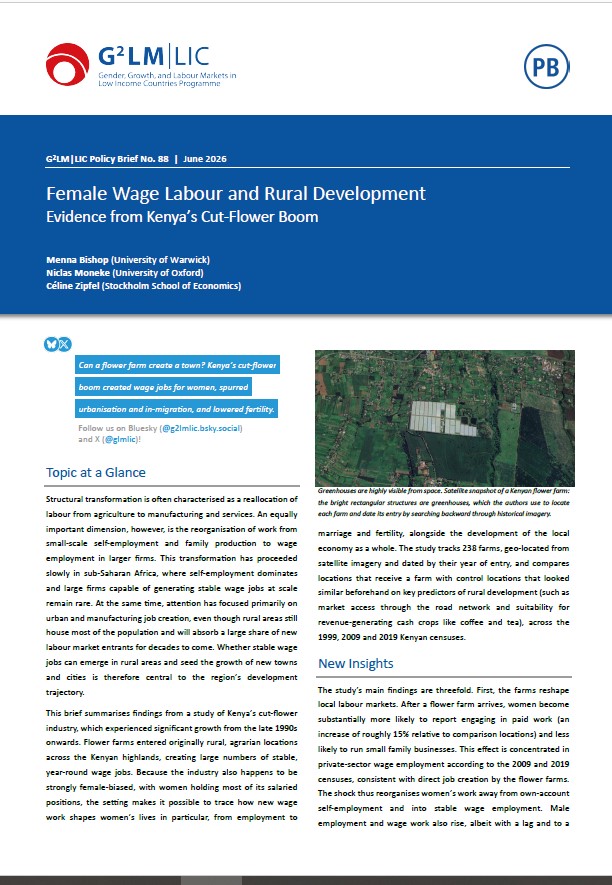
This brief summarises findings from a study of Kenya’s cut-flower industry, which experienced significant growth from the late 1990s onwards. Flower farms entered originally rural, agrarian locations across the Kenyan highlands, creating large numbers of stable, year-round wage jobs. Because the industry also happens to be strongly female-biased, with women holding most of its salaried positions, the setting makes it possible to trace how new wage work shapes women’s lives in particular, from employment to marriage and fertility, alongside the development of the local economy as a whole. The study tracks 238 farms, geo-located from satellite imagery and dated by their year of entry, and compares locations that receive a farm with control locations that looked similar beforehand on key predictors of rural development (such as market access through the road network and suitability for revenue-generating cash crops like coffee and tea), across the 1999, 2009 and 2019 Kenyan censuses.
Female Wage Labour and Rural Development
Evidence from Kenya’s Cut-Flower Boom
- Niclas Moneke
- Céline Zipfel
- Menna Bishop