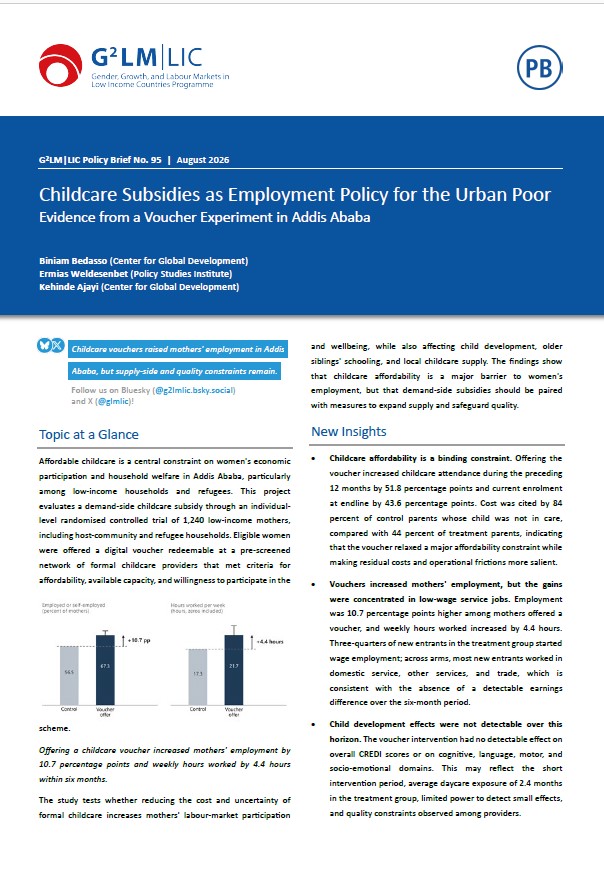
Affordable childcare is a central constraint on women’s economic participation and household welfare in Addis Ababa, particularly among low-income households and refugees. This project evaluates a demand-side childcare subsidy through an individual-level randomised controlled trial of 1,240 low-income mothers, including host-community and refugee households. Eligible women were offered a digital voucher redeemable at a pre-screened network of formal childcare providers that met criteria for affordability, available capacity, and willingness to participate in the scheme. The study tests whether reducing the cost and uncertainty of formal childcare increases mothers’ labour-market participation and wellbeing, while also affecting child development, older siblings’ schooling, and local childcare supply. The findings show that childcare affordability is a major barrier to women’s employment, but that demand-side subsidies should be paired with measures to expand supply and safeguard quality.