• Jobs of the World
  • Mentoring Programme
  • Login for Grantees
  • Code of Conduct
  • About
    • History
    • Investigators
    • Team
  • Projects
    • GLM|LIC
      • Agricultural Labour Markets
      • Gender and Employment
      • Labour Markets in Low-Income Countries
      • Migration
      • Skill Training
    • G²LM|LIC
      • Fact & Policy
      • Fertility & Labour markets
      • Barriers to gender parity
      • The Future of Work
      • Policies & Welfare
    • COVID-19
  • Publications
    • Policy Briefs
    • Synthesis Papers
    • Working Papers
    • Published Articles
    • Book
    • Datasets
  • Events
  • For Policy Makers
Search
  • Skip to main content
  • Skip to primary sidebar
G²LM|LIC Policy Brief No. 96

Beyond access: What has Ghana’s education expansion delivered?

New evidence on opportunity, work, gender and wellbeing

Fact & Policy
Education and Labour Market Dynamics in a Period of Rapid Education Expansion:

At the same time as Africa’s youth population is growing, governments across the continent are increasingly shifting policy focus to participation in secondary education to meet SDG 4. Ghana has already dramatically expanded access to secondary education, first through free, compulsory lower junior high in 1996 and, since 2017, free senior high school. This project asks what that expansion has meant beyond getting more young people into school. Understanding whether increased access translates into more equal opportunities, better work and wider benefits is important for assessing what education expansion ultimately delivers. Drawing on three decades of national surveys and data that followed the same people over four rounds we examine who progressed, whether educational opportunity became more equal, how work changed for women and men, and whether education is linked to wider benefits such as mental wellbeing. The results show substantial gains in schooling, but a more uneven translation into opportunity and work. They also show why it is still too early to judge the full effects of Free SHS: many of the first exposed cohorts are only now reaching the stages when longer-run education and labour-market outcomes can be observed.
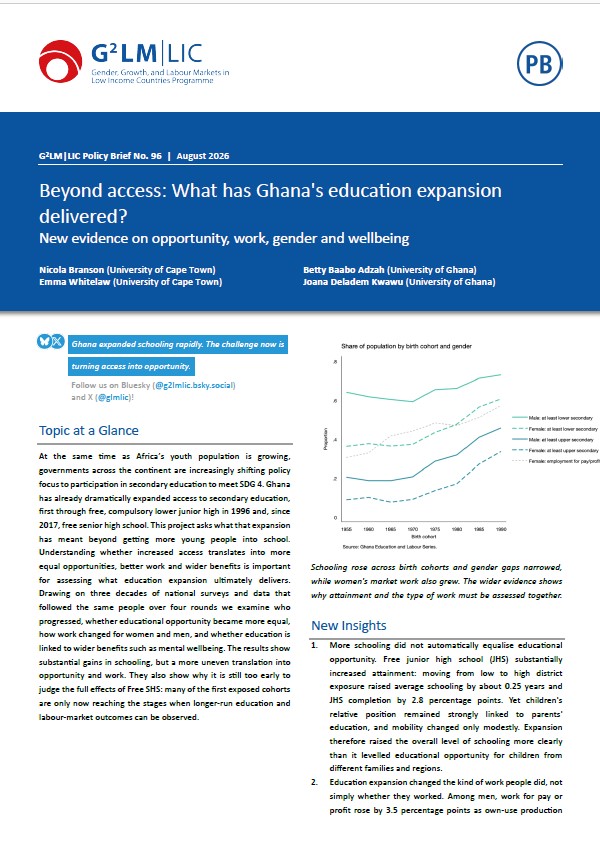
G²LM|LIC Policy Brief No. 96

Beyond access: What has Ghana’s education expansion delivered?

New evidence on opportunity, work, gender and wellbeing

  • Nicola Branson
  • Emma Whitelaw
  • Kwawu Joana Deladem
  • Betty Baabo Adzah
Download the PDF

sidebar

Subscribe to our mailing list
Contact us
Follow us on Bluesky
Follow us on X

Established in 1998 in Bonn, Germany, IZA is an independent, non-profit research institution supported by the Deutsche Post Foundation with a focus on the analysis of global labour markets. It operates an international network of about 1,500 economists and researchers spanning across more than 50 countries.

Based on academic excellence and an ambitious publication strategy, IZA serves as a place of communication between academic science and political practice.

The Foreign, Commonwealth & Development Office (FCDO) leads the UK's work to end extreme poverty. We're ending the need for aid by creating jobs, unlocking the potential of girls and women, and helping to save lives when humanitarian emergencies hit.

FCDO is a ministerial department, supported by 12 agencies and public bodies.

© 2012–2026 | IZA – Institute of Labor Economics | Code of Conduct | Imprint